


I’ve Been Gambling My Whole Life (And So Have You). BODIES & BOTS #12
 Reading Time: 4 minutes
When I was a kid, Grandpa Marty talked about his job at “The Track.”
I didn’t know exactly what that meant. I knew it involved horses, money, and a level of adult excitement that nobody fully explained to children. That was enough to make it feel glamorous and slightly forbidden.
That was my first lesson in risk. Learned secondhand, the way kids learn most important things.
Fast forward to my 20s. My aunts took me to the dog track on a business trip to Florida. I watched skinny dogs sprint in the heat while people screamed around them. Honestly? I felt terrible for the greyhounds. But I was fascinated by the people. What did they know that made this worth their time on a Saturday afternoon?
I left without placing a single bet. That has pretty much been my approach ever since.
Then came Vegas. Multiple times. Family trip…Blue Man Group, Krispy Kreme doughnuts for breakfast every single day. It’s a miracle we didn’t come back at 300 pounds with rotted teeth.
Work trips to Sin City came next. Conference appearances and various trade shows. A pool party with a GF that got slightly out of hand. My entire casino gambling career: one dollar in quarters, one slot machine. I haven’t been near a casino floor since they went digital. Something about inserting a coin felt tangible. Inserting a loyalty card into a machine that tracks your every move feels like something else entirely.

The house was always in the data business
My relationship with the casino industry turned out to be longer and deeper than a dollar in quarters.
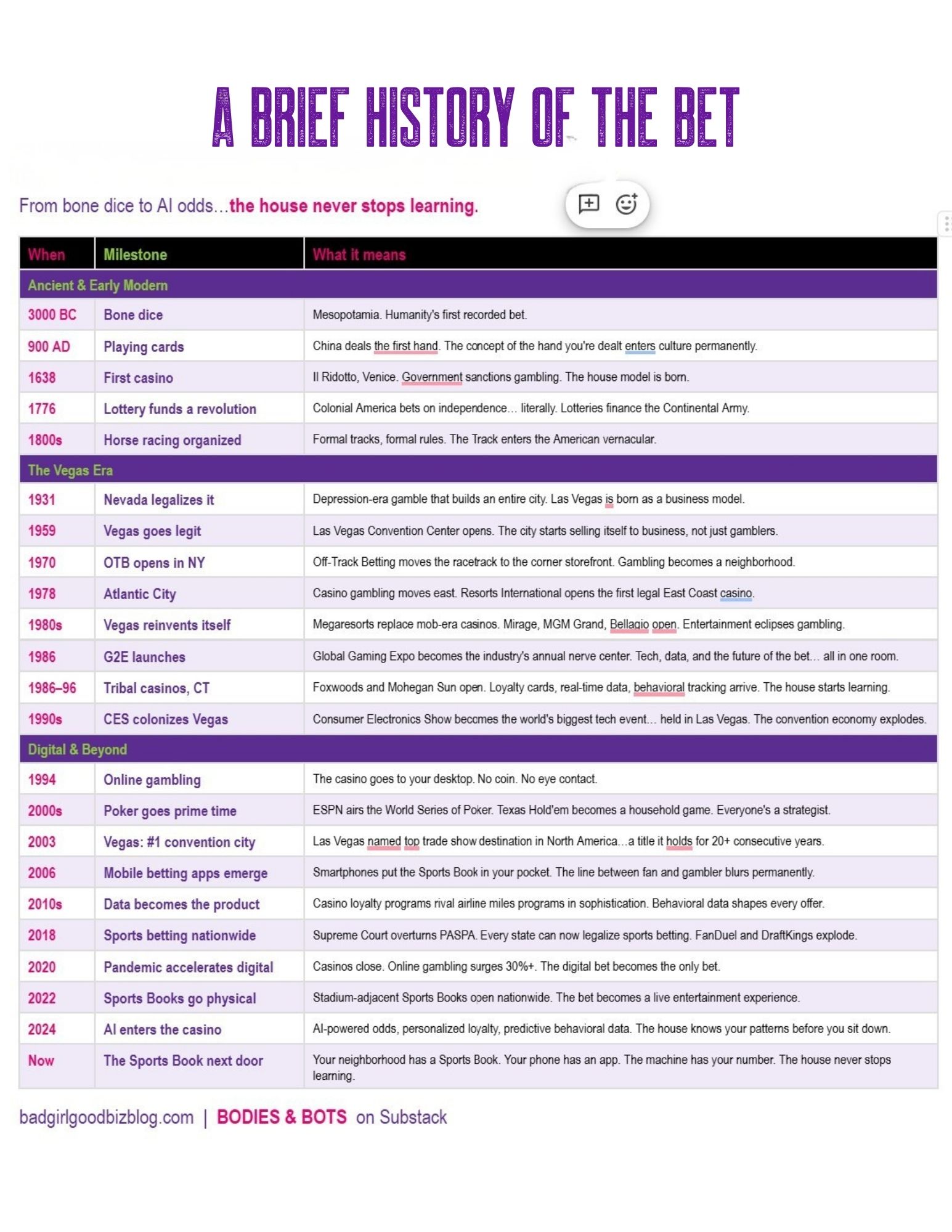
It started with the MasterCard team trip to the Connecticut casinos in the early 1990s. Not to play. To study. Because the tribal casinos were running some of the most sophisticated payment and loyalty technology anywhere in the world. Real-time transactions. Behavioral tracking. Personalized rewards before anyone called it personalization. The house wasn’t just winning. It was learning.
That curiosity followed me to Reed Exhibitions, where I helped launch G2E. The Global Gaming Expo isthe industry’s biggest annual gathering of casino operators, technology vendors, and everyone who makes the business run. I wasn’t a gambler. I was watching the machinery behind the curtain.
And then, years later, as a content strategist, I ghostwrote a Hot Pink Paper… my name for the kind of white paper that actually gets read…on casino industry trends. Same industry. Three different seats at the table. The same truth holds: casinos have always been early adopters. When technology shifts, they move first.
The real gamble was never at the table
We bet every single day in business. We just use cleaner words for it.
| What we call it | What it actually is |
|---|---|
| Launching a product | Betting your budget on unproven demand |
| Hiring someone |
Wagering six months’ salary on a stranger |
| Pivoting your model | Going all in with whatever chips you have left |
| Publishing an opinion | Putting your credibility on the table in public |
| Doing nothing | The most expensive bet of all |

What science actually says about risk-takers
Researchers have spent decades trying to understand what separates the people who bet well from the people who just bet. A few findings worth knowing:
- People with high self-belief and confidence in their own competence take more calculated risks across virtually every domain. Confidence isn’t arrogance. It’s fuel.
- Studies show positive emotions are linked to better risk decisions, while negative emotions drive impulsivity. The best time to make a big bet is when you’re in a good place, not when you’re cornered.
- People who see the future as open-ended take more risks, both positive and negative. Optimism isn’t naive. It’s a strategic advantage.
- Risk-taking and recklessness are distinct. One is calculated. The other is just noise.
What the smartest players have in common
- They know the difference between risk and recklessness. Risk is informed. Recklessness is hope in expensive shoes.
- They budget for loss. Failure is data, not defeat.
- They read people as well as numbers.
- They know when to leave. Nobody teaches this in business school.
- They play their own game, not someone else’s strategy with someone else’s hand.
- They make their moves when they feel good, not when they feel cornered.
The technology changed. The game didn’t.
The casinos I visited 30 years ago were early pioneers in personalization and behavioral data. Today every business has access to tools that make those early systems look like a flip phone next to a smartphone. But the fundamentals haven’t changed.
You still have to know your odds. Read the room. Decide every day which bets are worth making and which ones are just the smell of the crowd and the thrill of the lights.
I never put more than a dollar in a slot machine. But I have put everything on the line at work, repeatedly, for forty years. That is the only gambling that has ever felt worth it.
Want to go deeper on how AI and data are reshaping the casino and online betting world today? This week’s Substack has the full tech story.

Full disclosure: written with the help of AI. Which, when you think about it, is its own calculated risk.