



Life During Wartime: BODIES & BOTS #9
 Reading Time: 4 minutes
“This ain’t no party. This ain’t no disco.
This ain’t no fooling around.”*
I recently posted a photo of myself in a floral apron, holding a squirming baby robot, making the case for women in AI. Thirty thousand impressions.
And the whole time, somewhere in the world, people were dying.
I’ve been sitting with that tension. Not because it’s new. It isn’t.
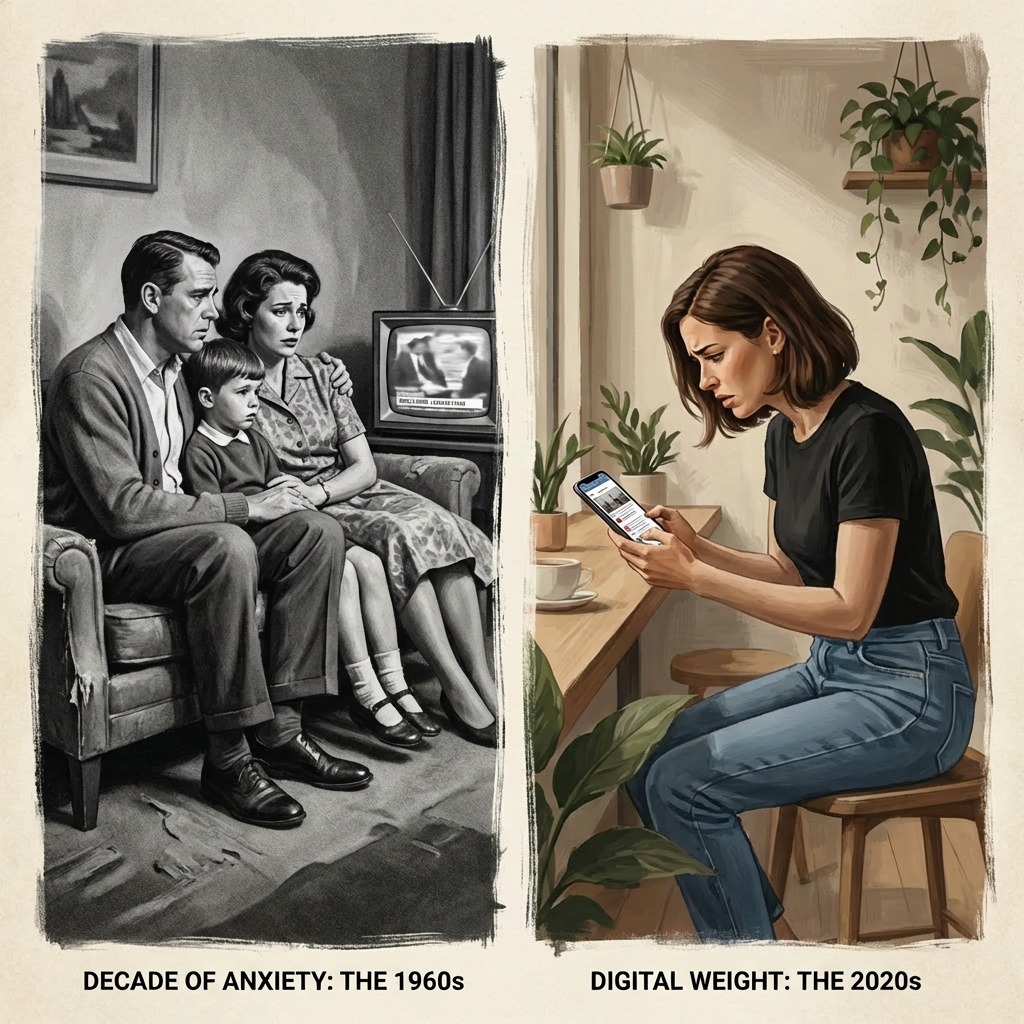
- I grew up during the Cuban Missile Crisis, when my parents were terrified in ways they couldn’t fully hide. It was 1962. I was six years old. I didn’t understand politics. I was just scared. We used to have drills throughout grade school. We hid under our desks, as if that would protect us!
- Boys my brother’s age were shipped off to Vietnam. Some came back. Some didn’t. We watched the war on black-and-white television. Kids walked out of school in protest in the 1970s, and the Kent State shooting horrified us.
- On September 11, 2001, I was running marketing for a conference company. I watched the towers fall. I was called into an all-hands company meeting while worrying about what I was going to tell my kids when I got home. A former colleague with four kids lost her husband that day.
- Talking to veterans and their families through volunteer work, I heard about the horrors of PTSD, addiction, and suicide.
We didn’t cancel. We kept going. Not out of obliviousness. Out of necessity. Joy and grief have always had to share the same calendar. As a mother and grandmother, I feel that in my bones.
Here’s what’s different now.
War isn’t just on the news. It’s in your business and in your face 24/7.
We used to gather around the TV as families. Walter Cronkite told us what happened, and we believed him. Not because we were naive, but because journalism had standards, gatekeepers, and a shared sense of civic responsibility. We had a collective grip on reality, even when that reality was hard.
Now we have something very different.
Millions of people whose entire online existence revolves around self-promotion and content output. The algorithm rewards engagement over accuracy. Some people are consumed by the news. Some are genuinely oblivious to it. And both carry risk.
Fake news has made it worse. Today, you see a conflict in a 15-second clip between a GRWM selfie video hyping a skin cream and a sponsored post, with no idea whether the footage is from yesterday, three years ago, or entirely fabricated. It’s relentless, intimate, and engineered to keep you activated. Which makes it harder to think clearly, lead calmly, and know when to speak and when to stay quiet.
War and violence have significant business impacts, too.
- 9/11 proved how fast conflict becomes commerce. The NYSE closed for six days. Just-in-time supply chains snapped overnight. New York City generates $1.2 billion in economic output per day. Every closed day was a clock running.
- Today, the Middle East digital economy is valued at $58.3 billion. Dubai and Abu Dhabi are serious AI hubs. Israel is a huge tech hub. That region supplies talent and capital to companies you use every day. So when conflict escalates there, it isn’t abstract. It’s your developer, your vendor, the founder on your Zoom call who looks like she hasn’t slept.
- 75% of employees now report low mood tied directly to global political turbulence. That’s not a wellness stat. That’s your productivity, your culture, your retention.
What to actually do.
Not perform. Not post. Do.
- Don’t weaponize it. The marketer who turns every crisis into a brand narrative is a type. Don’t be that type. Your audience has a long memory.
- Don’t take the bait. Whatever you post is an open door to people who see the world very differently. A comment thread can become a pile-on fast. You are not obligated to engage. “I hear you” is a response. So is silence. Firing back in public when you’re angry almost never ends well, whether it’s on LinkedIn, at a conference, or anywhere someone might be recording. De-escalation is a strategy, not a weakness.
- Keep showing up. Going dark doesn’t help anyone. The world gets better when people with ideas and platforms use them.
If you’re the one who can’t sleep.
- Set news hours. Mental Health America recommends specific check-in times rather than a running feed. Protecting your capacity is not abandoning the cause.
- Do one concrete thing. Volunteer. Share something vetted and useful. Helplessness feeds on inaction. Charity Navigator and GiveWell can help you find reputable organizations. If you’re a mother/grandmother like I am, check out groups like this.
- Tell one person. Not a thread. Not a post. One actual human being. Shared weight is lighter.
- Protect your routine. Move. Eat. You cannot control the news cycle. You can control whether you eat lunch.
- Give yourself a good day. Joy is not betrayal. Being a full human being while the world is also being terrible is not a contradiction. It’s survival.
I’m still here. Still making noise. That’s the whole strategy.
*With full credit and deep respect to David Byrne. He wrote “Life During Wartime” in 1979, watching his New York neighborhood come apart at the seams, with Cold War dread in the air and the future genuinely uncertain. The song landed in the Rock and Roll Hall of Fame’s 500 Songs that Shaped Rock and Roll. He made art anyway. That’s the whole answer, as far as I can tell.
P.S. I’m putting together a list of artists, activists, and everyday people who refused to go quiet during some of history’s darkest chapters. If you want it, subscribe to BODIES & BOTS on Substack and I’ll send it your way.