



Mom Rules: Why AI Needs Adult Supervision (And You’re the Adult): BODIES & BOTS #7
 Reading Time: 4 minutes
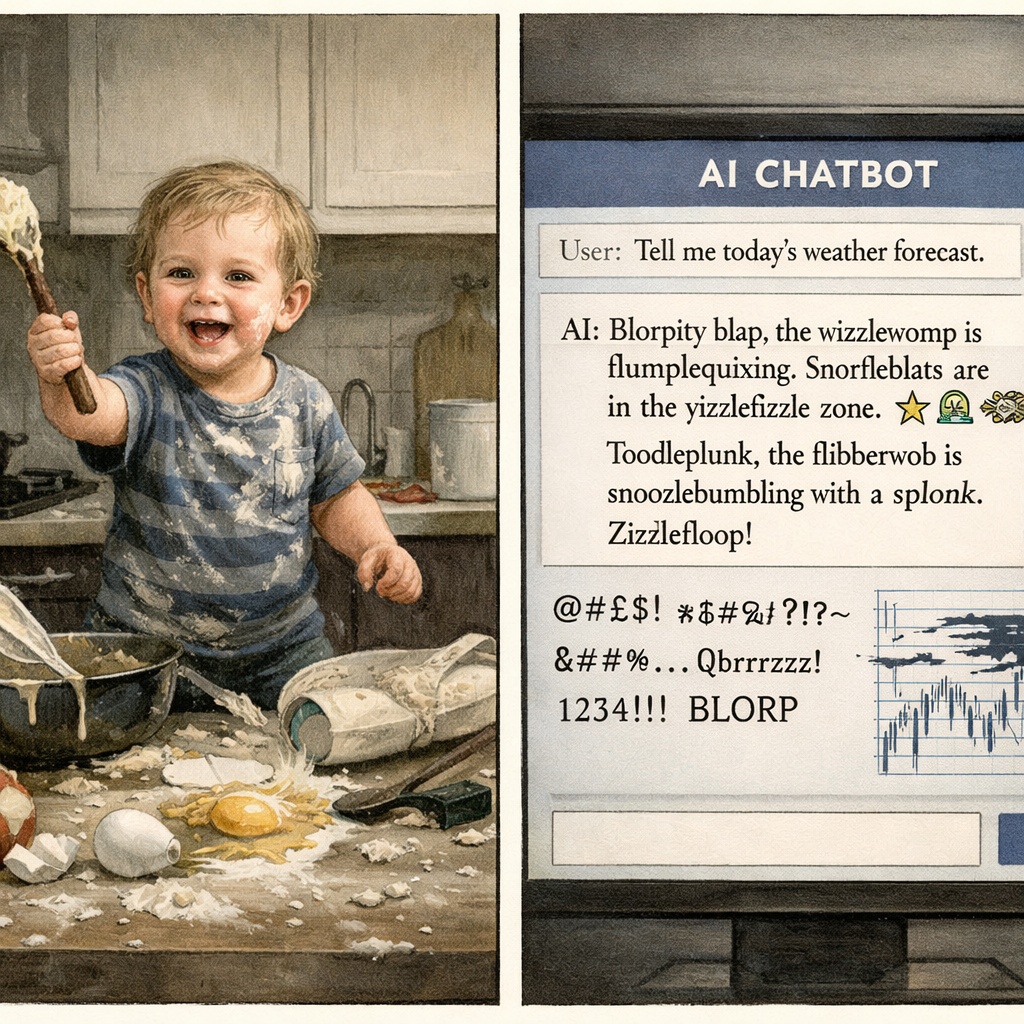
Every mother knows that moment.
You’ve left the kid alone for five minutes.
Just five.
That is AI without proper guidance.
I’m not kidding. After decades of managing people, brands, and bad decisions (some of them mine), I can tell you with complete confidence that prompting an AI agent is basically parenting. The stakes are different. The mess is different. But the fundamentals? Identical.
And here’s the thing, ladies (and other concerned parents): you already have the skills. You haven’t yet figured out how and when to use them.
Rule #1: Be Specific or Be Sorry
When you say “Clean your room” to a kid, you may come back in to find everything shoved under the bed or in a closet. Technically not wrong. Totally useless.
AI works the same way. “Write me a marketing email” will produce something that looks like a marketing email, just as a bed with lumps under it looks like a clean room. You have to be specific.
Tell it who the audience is. Tell it the tone. Tell it what you want them to DO after they read it. Tell it what to avoid. The more context you give, the better the output. Think of it less like giving an order and more like giving a proper briefing. Which, by the way, is also how you get a teenager to actually do the thing you asked.
Rule #2: Set the Guardrails Before It Goes Off-Road
Good parents don’t just react. They set expectations upfront. “Here’s what we do in this family. Here’s what we don’t do. Here’s what happens if you cross the line.”
AI needs the same treatment. Before you ask it to create anything, tell it the rules of your brand. Your tone. Your non-negotiables. Do you hate corporate jargon? Say so. Do you never use exclamation points unless you mean it? Say that too. Are there topics that are off-limits for your audience? Put it in writing.
Women: We need to push back on the hypersexualization of our images.
Agencies and marketing teams: Your AI prompts should incorporate brand guidelines. Every. Single. Time. Otherwise, you’re handing the keys to a kid who just got their learner’s permit and hoping for the best.
Rule #3: Check the Work. Every Time.
Even if you love your kids, you don’t blindly sign off on their homework.
AI hallucinates. It makes stuff up. It will confidently cite a statistic that does not exist, attribute a quote to the wrong person, or tell you that your competitor’s pricing is X when it is absolutely not X. It’s not lying. It’s more like a very eager intern who would rather give you an answer than admit they don’t know.
Review everything before it goes out. Have a human read it. Not to rewrite it from scratch, but to catch that heinous typo before your client does.
Rule #4: Teach It Your Voice
Kids absorb what’s around them. They pick up your phrases, your values, and your pet peeves. You shape them over time.
AI can be shaped too. Feed it examples of your best work. Tell it, “Write more like this and less like that.” Correct it when it’s off-base and explain why. The more you work with it and refine your prompts, the better it sounds like you rather than like everyone else using the same tool.
Rule #5: Remember Who’s in Charge
This is the big one. AI is a tool. A genuinely impressive, occasionally maddening, weirdly useful tool. But it doesn’t have judgment. It doesn’t have taste. It doesn’t know your client’s CEO hates buzzwords or that your audience rolls their eyes at anything that reads like a soul-less cut-and-paste message on LinkedIn.
You do.
The women in this room (virtual or otherwise) have spent years developing instincts, relationships, and expertise that no model can replicate. AI can help you move faster, do more with less, and even spur creativity and focus. But only if you’re the one in charge.
So yes. Give it structure. Give it context. Give it guardrails. Check its work. And never, ever walk away for five minutes without knowing what it’s doing.
I’ve been a mom longer than AI has existed. I’ve been running theONswitch since 2003 and wrote a book about AI in 2017.
I’ve been chatting about Life, Sex, and Tech without the filter at NANCYAF for more than a year.
And I can tell you from all of it: the instincts you’ve already got are exactly the ones this moment requires.
Ask any mother. The trouble always starts when you stop paying attention.
For more about AI from an OG of Tech, visit my Substack!

And now, because “mother knows best,” here are some compelling facts about women in AI and why we need to get more involved!
- Only 9.1% of AI specialists in the U.S. are women, according to U.S. Census Bureau data analyzed by Zippia, making AI one of the most gender-skewed technical fields in the country.
- Of the 6 million U.S. workers least equipped to adapt to AI-driven job loss, 86% are women, concentrated in the clerical and administrative roles that have historically defined female employment, per the Brookings Institution (January 2026).
- U.S. women’s adoption of generative AI tripled in a single year, but a trust and daily-use gap persists, with only 34% of female gen AI users engaging with it daily versus 43% of men, per Deloitte’s Connected Consumer Survey.
- Women are 11% more likely than men to see AI’s risks as outweighing its benefits, a gap that disappears when economic outcomes are certain, per a Northeastern University study published in PNAS Nexus (January 2026).
- 63% of AI professionals say machine learning will always produce biased results as long as the field remains male-dominated, per Deloitte’s State of AI report.
Interesting. Women definitely have to get more AI-literate. It’s the future whether we like it or not.
Absolutely! Using it to “cartoon” ourselves is fine, but it’s no where the jobs will be in the future!
Thanks for this. The fear around AI and what it will “do” to all of the different things will be the very thing that will allow all those “horrible” things to manifest. We must be literate! Not fearful.
Exactly, Pennie! Women (especially those of us 50+) can’t have it both ways. We want to earn our own money and have a seat at the table, but those of us who choose to remain ignorant or “rage against the machine” will be unemployable within 5 years.