


What We Watch: BODIES & BOTS #11
 Reading Time: 5 minutes
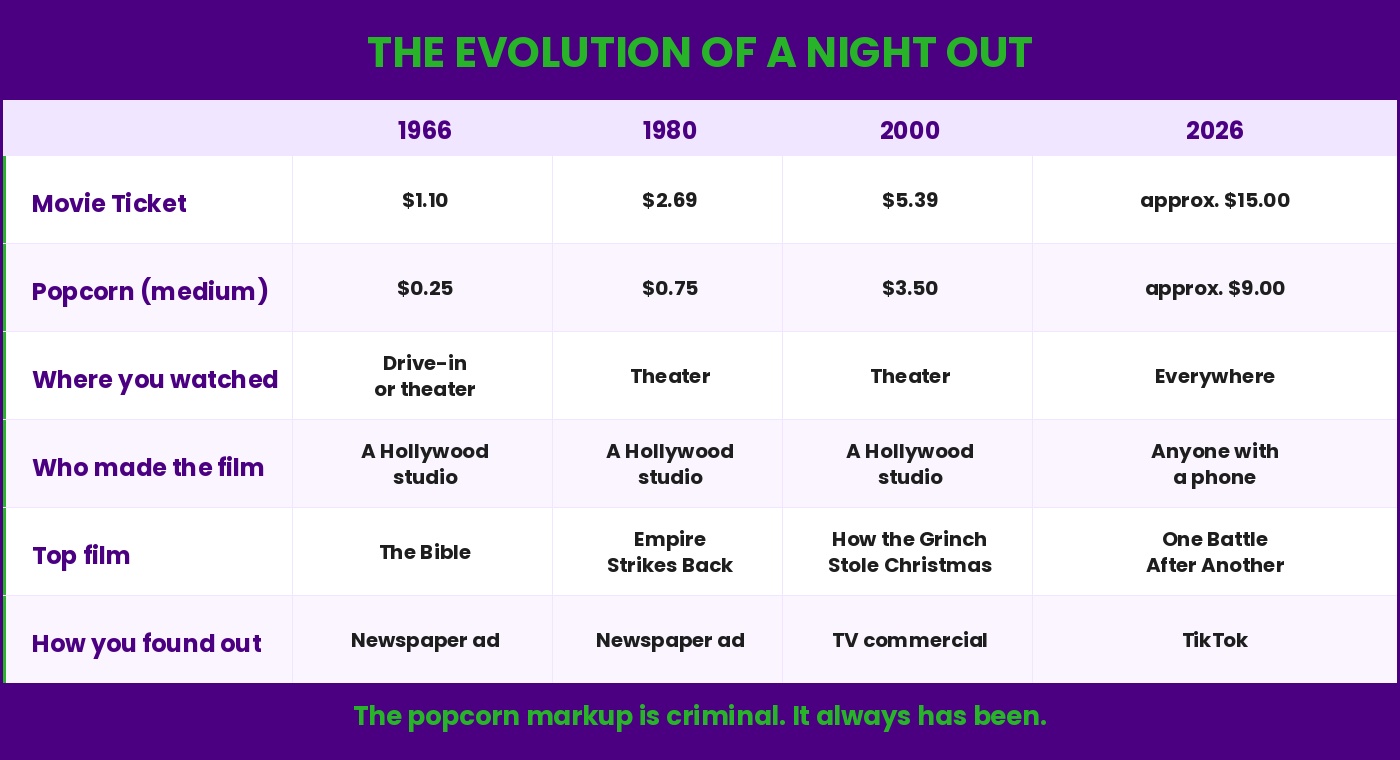
- “The Jungle Book” in my PJs at the Bridgehampton Drive-in
- “Bye Bye Birdie” with my mom and brothers at the Utopia Theater
- James Bond. Bikini-clad women. Spies. A high school date at the Century Meadows Theater with its giant screen
- “Jaws.” Vibrating seats when the shark appeared. That was high-tech
- Countless hours in front of a tiny B&W TV watching The Three Stooges, Superman, Soupy Sales,
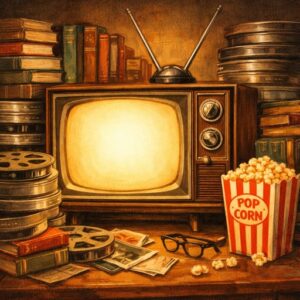 and Ed Sullivan
I checked out every book on film history from the library at age 12. Nerd much?
I read “Cue the Sun” (about the evolution of reality TV), stream series, make my own AI-assisted video shorts, and watch the Oscars every year. Some things never change.
Lights. Camera. Data.
- 82% of all internet traffic is now video [source]
- YouTube surpassed Netflix for US TV viewing time in 2025: 13.4% vs. 8.8% [source]
- People watch over 1 billion hours of YouTube daily [source]
- YouTube has become the #1 podcast platform, surpassing both Spotify and Apple Podcasts [source]
- Global box office hit $30 billion in 2024, nearly back to pre-pandemic levels [source]
- Streaming revenue now exceeds $100 billion annually worldwide [source]
- The average American spends 49 minutes a day on YouTube alone [source]
- Starting in 2029, the Oscars will move from ABC to YouTube. Make of that what you will [source]
The movie theater was supposed to be dead. It isn’t. People still leave the house for the right story. But where and how they watch everything else has changed completely.
Your Brain Bought a Ticket Too
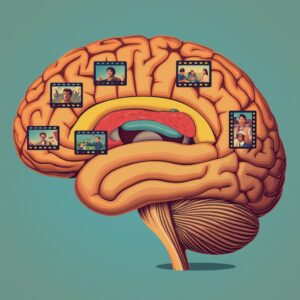 Turns out screen-watching isn’t as passive as your mother thought.
MIT neuroscientists recently mapped 24 distinct brain networks that activate during movie watching. [source] During an intense scene, up to 70% of a theater audience’s brain activity is synchronized — you are literally thinking the same thoughts as the stranger next to you. [source] Oxford researchers found that movies create a “flatter” brain hierarchy, requiring less neural effort…that’s the science behind why a good movie feels like a mini-vacation. [source]
Advertisers have known this for decades. Marketers are just catching up.
Same Time. Same Place. Same Gold Man.
98 years. Still the #1 primetime entertainment telecast of the season.
17.9 million viewers watched this year on ABC and Hulu, down 9% from last year’s post-pandemic high. [source] For context, ten years ago, in 2016, Oscar ratings reached nearly 35 million viewers. [source] That’s a loss of 17 million people.
And yet. Social impressions for the Oscars hit over 184 million, up 42% from last year, with over 129 million video views throughout the night. [source]
Fewer people are watching on TV. Everyone is talking about it everywhere else. That’s not decline. That’s fragmentation. Big difference.
The constants:
- Speeches still run long
- Fashion still generates more conversation than the films. This year: mostly-naked women with wax faces who looked like they hadn’t eaten in days. Men with brooches. The discourse was loud
- Politics have always been part of the show. Always. This year was no different
- The In Memoriam segment ran longer than ever. Are we more sentimental? Or are more of us dying? Probably both
- Burger King sponsored the show and “fired the king” on air, declaring a commitment to humanity and its customers. Noble. Those burgers will probably be made by robots soon enough
- Amy Madigan. 75 years old. First Oscar. Forty years after her first nomination. Playing a parasitic witch. Doing her own stunts. Ed Harris in the audience. She thanked him for a “long a– time” of marriage. The crowd lost it. That’s not Hollywood. That’s human
The Script Got Rewritten
- A new category: Best Casting. First new Oscar since 2001. Translation: human actors may actually
 be here to stay
 - “Sinners” broke the all-time record with 16 nominations, surpassing the previous record of 14 held by All About Eve, Titanic, and La La Land. A Black-led horror film set in 1932 Mississippi. [source]
- First woman ever to win Best Cinematography in the show’s 98-year history: Autumn Durald Arkapaw for “Sinners”
- This year’s theme from the producers: “celebrating actual intelligence, not artificial intelligence.” AI, Amazon as a film studio, and vertical format viewing were all referenced on stage. The industry knows what’s coming
- Conan O’Brien poked fun at the YouTube deal on air, running fake pop-up ads. In 2029, the Oscars will move to YouTube through at least 2033. The future has arrived
- The merch and social media machine now runs for days before and after the show. The Oscars are no longer a single night. They’re a content ecosystem

Here are my predictions…
- AI changes production. Not storytelling. The tools get faster and cheaper every month. Anyone with a concept can now produce professional-looking content. But the stories that break through will still have a human heartbeat. The Oscars literally gave an award this year to prove it.
- The theater survives as an event. IMAX. Immersive sound. Premium seating. The casual multiplex trip keeps fading. The destination experience grows. People will pay to feel something enormous in a room full of strangers. Just look at The Sphere in Las Vegas. People don’t go there for content. They go for the experience of being inside something massive and immersive.
- Stories lead. The world follows. Film has always been ahead of its time. “In the Heat of the Night” won Best Picture in 1967. “Brokeback Mountain” made studios nervous in 2005. “Black Panther” changed what a blockbuster could look like in 2018. This year, “Sinners” put a Black-led horror film at the top of Oscar history. Stories don’t just reflect culture. They pull it forward. The most powerful films of the next decade will feature faces and voices that boardrooms and legislatures haven’t yet caught up to. They never do. Hollywood gets there first and (hopefully) gets us talking.
Scroll or Soul?
Anyone can shoot. Not everyone can tell a story.
Short-form video has democratized production. Anyone can shoot, edit, and distribute. That’s real, and it matters.
But holding someone’s attention for 15 seconds is not the same as holding it for two hours. Virality is not craft. A TikTok that makes you laugh is not “Sinners.” A Reel that stops your scroll is not “Citizen Kane.”
The question nobody in the content industry wants to answer out loud: Just because we watch something, does that make it good? And just because we can make something, does that make us storytellers?
The Oscars exist precisely because that distinction still matters to someone.
I started at a drive-in in the Hamptons watching a cartoon bear.
I now produce AI-assisted content and watch multiple screens before noon.
The format has changed. The hunger for story hasn’t moved an inch.
And neither has the popcorn.