


The Robots Are Smiling and Dialing: BODIES & BOTS #10
 Reading Time: 7 minutes
How PR Got Blown Up (And What’s Left for the Humans)
It was the late 1970s. I was young, ambitious, and sitting in front of an actual paper directory the size of a phone book. My job was to find journalists, call them on a corded telephone, smile (yes, you can hear a smile), and pitch a story. I called it “look-up, smile, and dial.” It was the whole job. That and babysitting clients when they appeared on TV and radio. And sitting next to them when they met (like in the real world) with reporters. Meetings with journalists were called “desksides,” because we had desks (usually with ashtrays and all kinds of weird plaques and lucite awards). When clients appeared in the news, we had to cut out clips with real metal scissors and put them in binders. Enough geezer history!
Fast forward to 2026. The robots are doing the smiling and dialing now. And “journalist” is a word that needs serious air quotes in many contexts.
PR has not just evolved. It has been detonated, rebuilt, detonated again, and now it’s running on an algorithm while half the industry pretends nothing has changed.
BTW…public relations is (technically) the art of earning media coverage you didn’t pay for. But in 2026, good luck explaining where ‘earned’ ends and “paid” begins. And while you’re at it… Try defining “the media.”
From Paper Books to Bots: A (Very Compressed) History
Here is the condensed version of how we got here:
| Era | The Big Disruption |
|---|---|
| 1970s-80s | Paper directories, corded phones, press releases typed on actual typewriters. Relationships were everything. The Rolodex (Google it) was your superpower. |
| 1990s | Journalist databases (Bacon’s, PR Newswire, Business Wire) arrived. Email killed the cold call. The Rolodex started gathering dust. |
| 2000s | The internet blew up the newsroom. Blogs became media. Anyone with a WordPress account was a “publisher.” Pitching got faster, cheaper, and a lot noisier. |
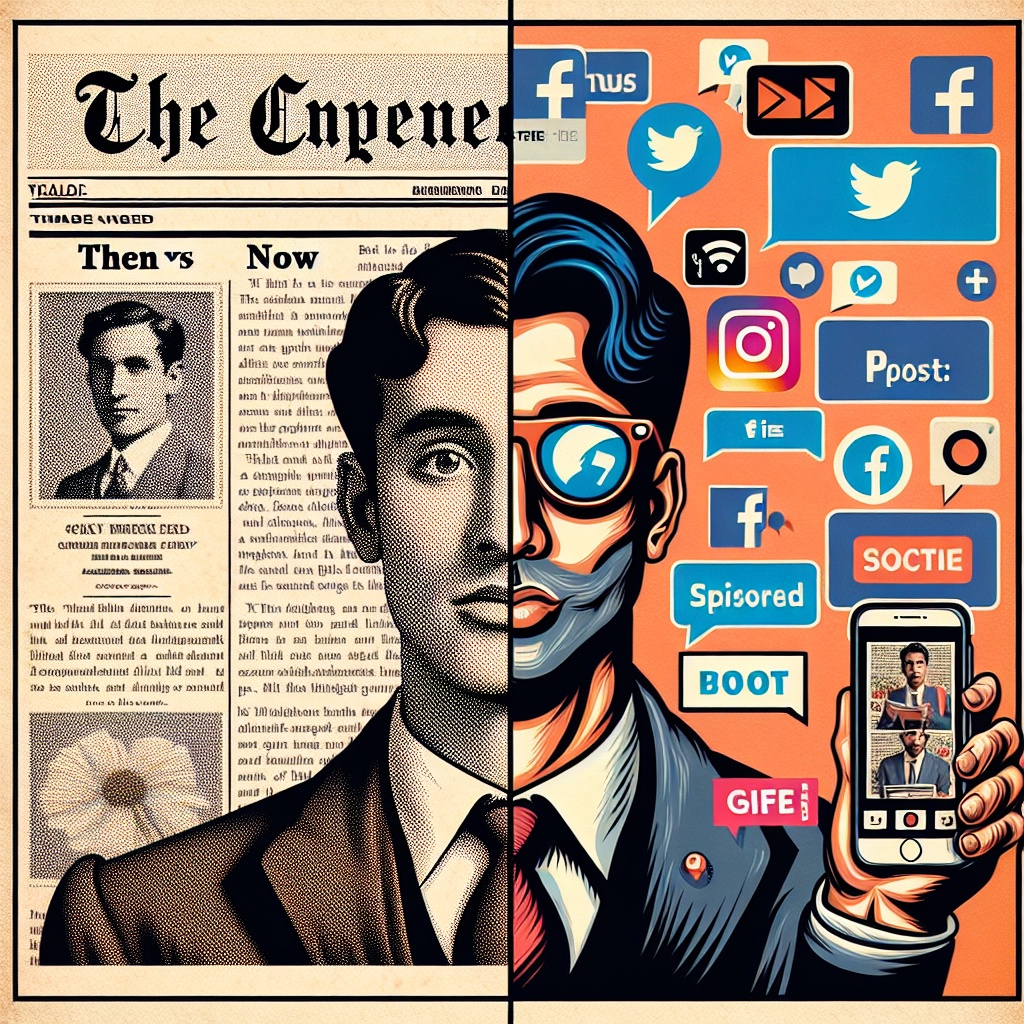
| 2010s | Social media made everyone a broadcaster. Twitter became a breaking news wire. Facebook became a media empire. Instagram made influencers the new press corps. Traditional media shrank. |
| 2017+ | AI-powered PR tools began automating pitching, media monitoring, and content generation. (Spoiler: I saw this coming. More on that below.) |
| Now | Generative AI writes press releases, answers journalist queries, distributes content, and increasingly decides what gets amplified. The bots are running the newsroom. |
Is That Even News? (Asking for a Profession)
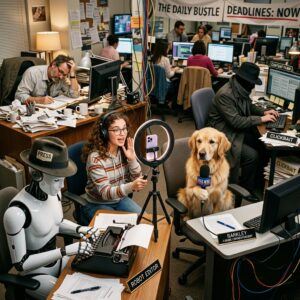
The modern newsroom?
Let’s talk about what “news” even means anymore, because that is the foundation that PR was built on, and it has cracked.
Some sobering facts:
- Newsroom employment in the U.S. has dropped about 26% since 2008, with digital-native newsrooms only partially filling the gap.
- About 2,500 local newspapers have closed since 2005, leaving vast “news deserts” across the country.
- Sponsored content (a.k.a. “native advertising” a.k.a. “pay for play”) now represents a significant and growing share of digital media revenue. What used to be a dirty word has a content strategy and a rate card.
- According to the Reuters Institute Digital News Report, trust in news is near record lows in most countries.
- Fact-checking? There are now entire organizations dedicated to it (PolitiFact, FactCheck.org, Snopes) because publications stopped doing it themselves.
The definition of “journalist” is now so elastic it includes a teenager with a Ring light, a brand “thought leader” who has never reported a single original fact, and a state-sponsored content farm in a country you can barely find on a map.
I Told You So: The 2017 Bot Prophecy
In 2017, I wrote a book predicting a near future in which AI bots would essentially be pitching other AI bots. The PR pro pitches a distribution algorithm. The algorithm decides what gets surfaced. A language model writes the response. A brand publishes it as “coverage.” The human is somewhere in the middle, desperately justifying her retainer.
Here’s what I did not fully anticipate: the rise of “citizen journalists” and outright fake news operations running parallel to and sometimes more successfully than legitimate media. When I wrote that prediction, I thought AI would primarily disrupt distribution. What I underestimated was how thoroughly it would disrupt trust.
The tools that now exist for PR professionals (and anyone else) include:
- Cision and Muck Rack, which use AI to match pitches to journalists and track earned media coverage. [source]
- ChatGPT and Claude, which can draft press releases, talking points, and crisis communications in seconds.
- AI-powered media monitoring platforms that track brand mentions across millions of sources in real time. [source]
- Automated wire services and newswire syndication that can flood the zone without a single human editor. [source]
- Generative video and image tools that create “press-ready” visuals without a photographer in sight.
Why Some PR Pros Are Still Dancing on the Deck of the Titanic
The PR industry is not stupid. It knows things have changed. And yet.
Some practitioners are still leading with “relationships with journalists” as if that is a complete value proposition in 2026. Relationships matter. They absolutely do. A great journalist connection can still get you into a story that an algorithm never would. But a relationship without strategy, digital fluency, and an understanding of how content actually travels today is just a nice lunch.
And even when you do land coverage, the clock is already ticking.
Research shows the biggest news stories of any given year last a median of seven days in the public consciousness before searches drop off. A tweet promoting that story? Eighteen minutes.
The real problem: many PR agencies and in-house teams still charge for outputs (press releases, pitches, placements) rather than for outcomes (reach, trust, authority, conversions). The industry has not fully reconciled its pricing model with its new reality.
I reflected on the early days of change in 2019, but (ironically) the platform I wrote for has become a bit of a dinosaur.
Some things have not changed as much as we think. Some have changed more than we are ready to admit.

So What Do You Actually Do With All This?
For PR professionals who want to stay relevant and not become the human equivalent of a fax machine, here is the honest checklist:
- Stop apologizing for and fearing or dismissing AI and start using it strategically. The pros who figure out the prompt-to-placement pipeline first will own the next decade.
- Know the difference between a journalist, a content creator, and a bot persona. They require completely different relationship strategies and pitching approaches.
- Understand the media business model of every outlet you target. Is it advertiser-supported? Subscriber-funded? Sponsored content-dependent? That changes everything about how you approach them.
- Build owned media like your career depends on it. Because it does. Email lists, Substacks, podcasts, and long-form content are now essential complements to earned media.
- Learn to read analytics. If you can’t explain what earned media did for your client beyond “we got a placement,” you are in trouble.
- Get comfortable with AI tools for monitoring, writing, and distribution. Not as a replacement for strategy, but as the engine that executes it.
- Protect and nurture your real human relationships. With real journalists. With editors. With producers. These connections are now rarer and therefore more valuable, not less. I booked my last few podcast guests after conversations (voice-to-voice) with PR professionals.
The Bottom Line
PR is not dead. Not even close. But it is unrecognizable from where I started, and that is not a bad thing for the people willing to evolve.
The robots are smiling and dialing. Some of them are pretty good at it. But they still can’t read a room, build trust over a decade, or know that the best time to call a journalist is never on a Tuesday at 4pm.
The professionals who survive and thrive are the ones who know when to hand the phone to the bot and when to pick it up themselves. It’s a skill, not a strategy. And it takes a human to know the difference.
Want more on navigating the new PR landscape? Subscribe to BODIES & BOTS on Substack for the intersection of humans, technology, and what happens when the two collide.
Subscribe to BODIES & BOTS on Substack
And yes…full disclosure…I wrote this with the help of AI. And I wrote it on a Lenovo laptop rather than a manual typewriter. If you have a problem with any of that, please call me to discuss on my phone. It no longer has a cord.
My Fellow Game-Changers and Innovators
These are the PR and communications professionals I’m watching closely, because they’re not waiting for the industry to catch up. They’re building the road.
Disclosure: This list was researched and compiled with the help of AI. Because of course it was.
- Gini Dietrich (Spin Sucks / Arment Dietrich) — Creator of the PESO Model, integrating AI into PR frameworks since 2017 and now leading the conversation on LLM visibility as the new frontier of earned media.
- Richard Edelman (Edelman) — Running AI advisory sessions for C-suites globally and leading the trust-and-AI conversation at the biggest agency on the planet.
- Fred Cook (USC Annenberg Center for Public Relations) — Publishes the annual “AI Activated” Relevance Report and has been sounding the alarm (and the opportunity bell) loudly.
- Azadeh Williams (AZK Media) — Award-winning PR and marketing leader specializing in AI and enterprise tech. Named PR Professional of the Year by Mumbrella in 2024.
- Melanie Klausner (Havas Red) — Pushing the industry toward Generative Engine Optimization (GEO), the idea that earned media now feeds LLMs, not just search rankings.
- Rob Key (Converseon) — Focused on making brand data “AI-ready” so what gets surfaced in LLM responses is accurate, not a hallucinated mess.
- Dan Brahmy (Cyabra) — Building AI tools specifically to detect deepfakes and disinformation campaigns before they torch a brand’s reputation.
- Michelle McIntyre (Michelle McIntyre Communications) — Independent PR pro and vocal advocate for using AI smartly in research and media database building, while keeping human relationships at the center.
- Meiko S. Patton (USPS / Ragan’s Center for AI Strategy) — AI communications specialist making the case that PR sits at the very epicenter of AI transformation.
- Guy Abramo (Cision) — Leading the charge on measuring AI’s role in PR workflows. His Inside PR 2026 report found that 91% of pros are now using generative AI in their work. The robots have officially landed.